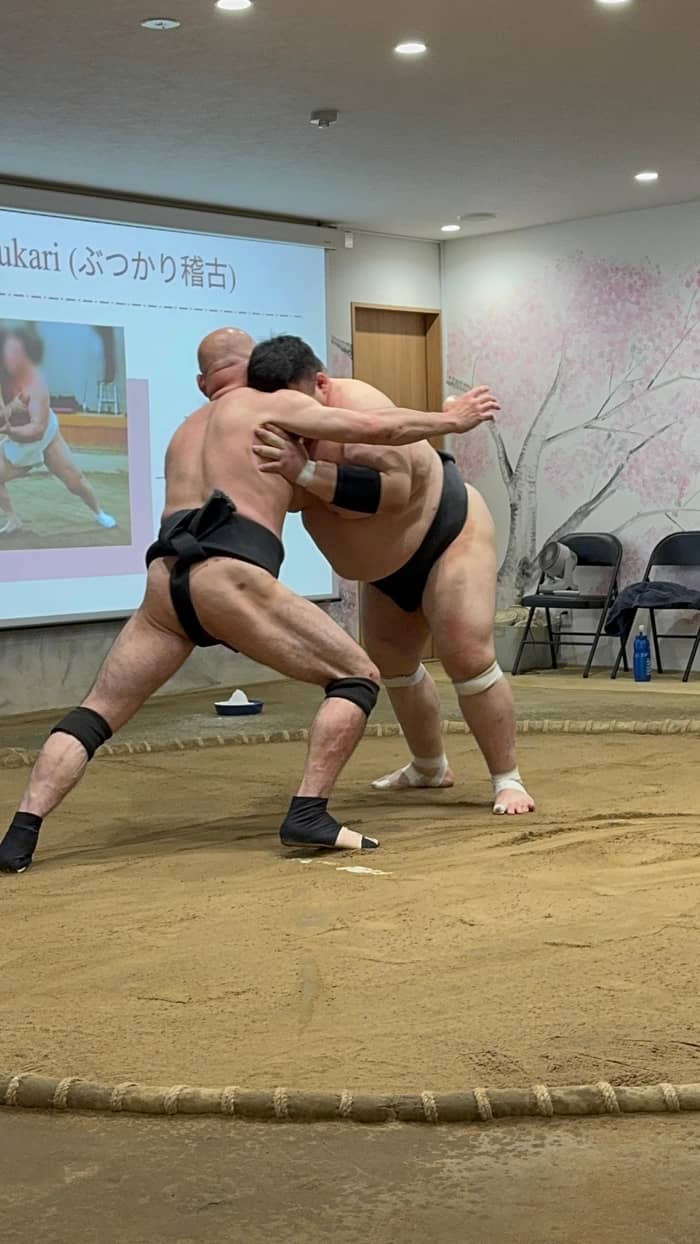
Our show
Show in Hanazonocho
Our show, English guide
- LengthRuns 1.5 hours
- Pricefrom $62
- Ring challenge30 minutes, limited spots
Guides
Language
Currency
Check open spotsstarting at $62 · free cancellationChecklist you can tick
Fast answer
The sumo rules for first-timers are simple: the first wrestler to step outside the ring or touch the ground with anything but the soles of the feet loses.
Bout basics
To-do list · 10 items
Tick off each point as you complete it. This device keeps your progress.
0 / 10 ready
All done. Only the booking is left: your date and your place at the ring.
Save a placeA newcomer in the stands needs only a handful of ideas: who wins, why the salt flies, how short a match can be and how the day is ordered. This guide gives them in plain order and points to the Osaka hall and shows where you can see them live.
Editorial team, osakasumo.top · Updated November 6, 2026 · Quick read: 6 min
Basics
The rules fit in a paragraph. GO TOKYO puts the rule this way: whoever steps outside the dohyo first, or touches the floor with anything except the soles of the feet, loses.1 JNTO describes the same result from the winner's side: a wrestler wins by driving the opponent out of the ring or making him touch the ground with anything but his soles.4 If you remember only those lines, you can follow every bout in the hall. None of this needs a translator once you are inside: the action explains itself within the first few bouts.
Judgement is human, and it is part of the charm for a newcomer who expects a scoreboard. GO TOKYO notes there is no video replay and no electronic assistance, with the results judged by professional referees lined up outside the ring, and a rematch in rare inconclusive cases.1 That matters for how the crowd behaves: a close finish is settled on the spot, and the next pair walks to the ring.
The moves themselves are many. GO TOKYO says wrestlers may use many different moves, so long as it is not a closed fist, and that the belt, called the mawashi, can be grabbed to force the opponent out of the ring.5 Together those two facts account for the shapes you see: grappling at the belt, slaps with an open hand, and shoulder charges. Watch the hands: an open palm to the chest is part of the sport, a closed fist is not, and the belt is a handle for the wrestlers rather than a decoration.
Words you will hear
| Term | Plain meaning | Where you meet it |
|---|---|---|
| Basho | A grand tournament | Six held a year, with Osaka's in March.7 |
| Rikishi | A wrestler | The large wrestlers who grapple for advantage.2 |
| Dohyo | The ring | Stepping outside it loses the bout.1 |
| Mawashi | The belt | It can be grabbed to force the opponent out.5 |
| Makunouchi | The top division | Its wrestlers enter the ring after the lower divisions.8 |
| Musubi-no-ichiban | The final bout of the day | Excitement peaks at this bout.6 |
| Shokkiri | Comic sumo | Seen on the provincial tour, not at the Grand Tournaments.9,10 |
The terms and their meanings follow the Japan Sumo Association, JNTO and GO TOKYO pages cited in the sources list.1
People often ask how long a sumo match lasts, and JNTO answers it. Many bouts end within seconds, when one wrestler throws the other off balance at the outset, while others run for several minutes as the large wrestlers, called rikishi, grapple for advantage.2 The shortness is part of the design. What fills the time is the ritual.
Before the charge there is an elaborate ritual: salt thrown to purify the ring and a series of bows to the opponent.4 GO TOKYO calls the salt a purification ritual meant to ward off evil spirits and to ask for blessing and a bout without injury.3 The stare-down and the crouch are part of the show, so a bout of seconds sits inside minutes of ceremony.
That rhythm shapes a day. A long afternoon is a series of short, intense bouts separated by salt, bows and the walk of the next pair. The Association describes the final bout of a day as the musubi-no-ichiban, where the level of excitement reaches its peak.6 Before you sit down in a hall, decide what you want from the day: the early bouts for the sheer variety of body types and styles, or the afternoon for the stars. A first-timer who knows to expect that shape will not feel cheated by a very short finish. Watch the first moment of contact, listen to the crowd, and let the referees' decision close the bout.
One bout
Before the charge
A ritual of purifying salt comes first.4
Still before the charge
A series of bows to the opponent follows the salt.4
The charge
The wrestlers charge into each other.4
Seconds or minutes
Many bouts are over in seconds, others go on for several minutes.2
The finish
The first to leave the ring or touch the ground with anything but the soles loses.1
The rare case
In rare inconclusive cases the result is a rematch.1
JNTO says professional sumo has six divisions that are not delineated by weight, so a contest is often between an extremely large and strong wrestler and a more slender but nimble opponent, and that wrestlers move up or down the divisions depending on their results.13 A small man can beat a giant here, and watching the lower divisions first is worth your time.
The order of a day follows the divisions. On the Association's provincial tour, the Makushita wrestlers and those below warm up first, the top Makunouchi division follows, and the Yokozuna and Ozeki close the session.8 At the Osaka tournament the matches fill the span from 8:30 AM to 6:00 PM on JNTO's account, and Ticket Oosumo set the main top-division bouts at around 2 PM.14,15
The Association calls the Yokozuna ring-entering ceremony the highlight of all ring-entering ceremonies, a spectacular expression of the sport's 1,500-year history.16 JNTO adds that sumo is believed to have emerged as a ritual dance to entertain the Shinto gods at shrine festivals, with its rules established in the Edo period.17 Knowing the ritual roots makes the slow parts of the day feel intentional. When the hall seems to wait, it is waiting for the salt, the bows and the crouch, which are the sport and not a delay.
Your first sumo
Match what you want to learn to where to learn it.
If I want to see a real tournament
Go to the March basho in Osaka
Osaka hosts one of the six yearly tournaments, in March.7
If I want an English guide to explain it
Book a show with commentary
Our listing has a live guide in English and a talk titled What is Sumo.
If I want to wear a mawashi
Try a challenge experience
Active Square Daito lets you wear a mawashi and learn from amateur wrestlers.11
If I do not want to sit on the floor
Choose a chair seat
Box seats are floor seating, while chair seats are not.12
If I want rules only, quickly
Read the summary at the top
The winning rule fits in a single sentence.1
Try it
Our show
Our show, English guide
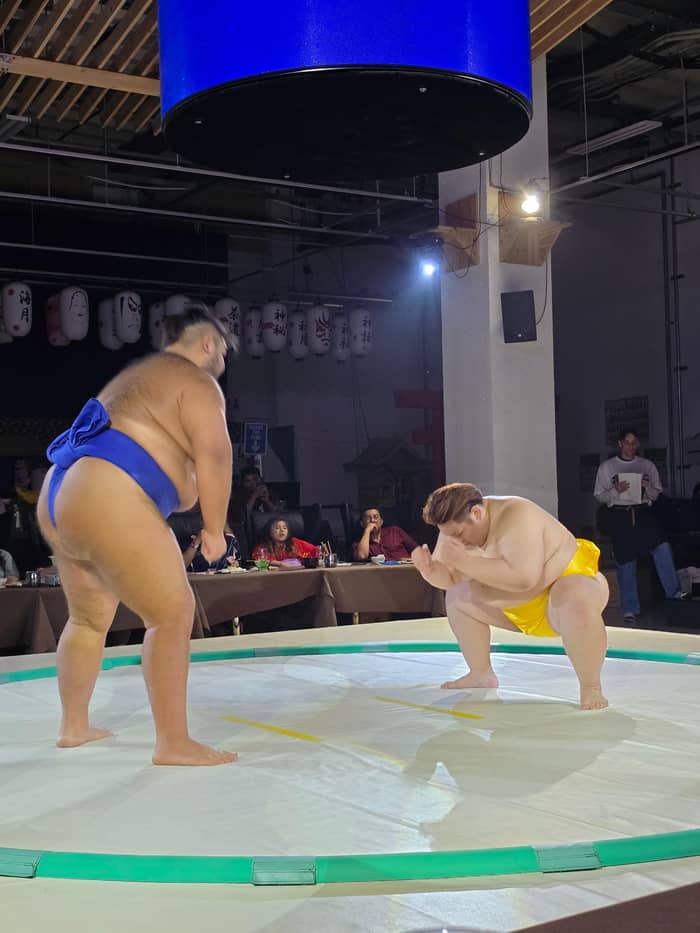
Hands-on
Near JR Imamiya Station
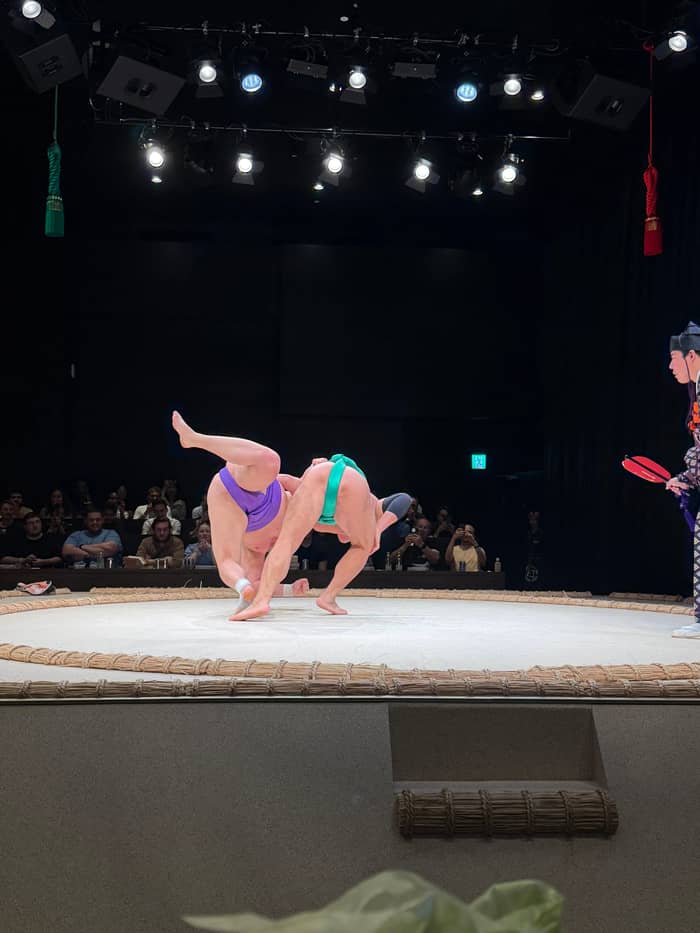
Namba show
Namba Parks, 8th floor
GO TOKYO says there are no TVs inside the arena, sponsors appear on cloth banners carried around the ring, and the crowd gets loud during epic matches.18 JNTO tells visitors to the Osaka arena to expect loud cheering for local favorites from the Kansai region.19 The hall is a lively place, not a quiet museum, and the volume rises with the stakes: by the last bouts of the day the building is loudest.
A box seat is floor seating: shoes come off, 4 guests share a box and its cushions, and boxes are not sold by the seat.20 GO TOKYO notes that the cushions can feel snug to Western visitors, and that a table seat with chairs may suit a full day better.12 Children aged 4 or older need a ticket.21 A chair also leaves you free to stand and cheer.
On the day, one ticket covers every match, you may come and go during the day but re-enter only once, and Ticket Oosumo advises caution about resale sites.22,23 GO TOKYO says sumo is very popular and tickets should be reserved well in advance, and notes that tickets for all 90 sumo match days sold out in 2024 for the first time in 28 years.24,25
Price your group
Set the number of guests and see the from price of each listing.
Compare 4 alternatives
Set the number of guests and see the from price of each listing.
≈
View≈
View≈
View≈
ViewFrom-prices on GetYourGuide, shown at the ECB reference rate. Your exact price is confirmed during booking.
If you are wondering how to sumo yourself, the answer is a ring, a mawashi and an instructor. Our Osaka Sumo Experience builds its middle 30 minutes around a ring challenge, framed by a 40-minute demonstration and match and a 20-minute talk called What is Sumo; only a limited number of guests get a turn against a wrestler. The listing is 1.5 hours long, takes up to 53 people and starts at $62.
The Osaka Convention & Tourism Bureau describes Active Square Daito, where amateur wrestlers instruct you on a real ring that uses the same soil as the Kokugikan, and where you can wear a mawashi.26,11 A second bureau page says women can wear sumo suits and enter the ring, which is normally off-limits to women.27
A third route is a show at Osaka Sumo Kaminari Ichimon, a 3-minute walk from JR Imamiya Station, which lists former professional wrestlers, English narration and a step onto the ring, from $44. None of these replaces a tournament. Each is a way to feel the weight and the technique in your own legs before you watch the real thing. Ask the venue about age and fitness limits before you book, and wear clothes you can move in.
Video
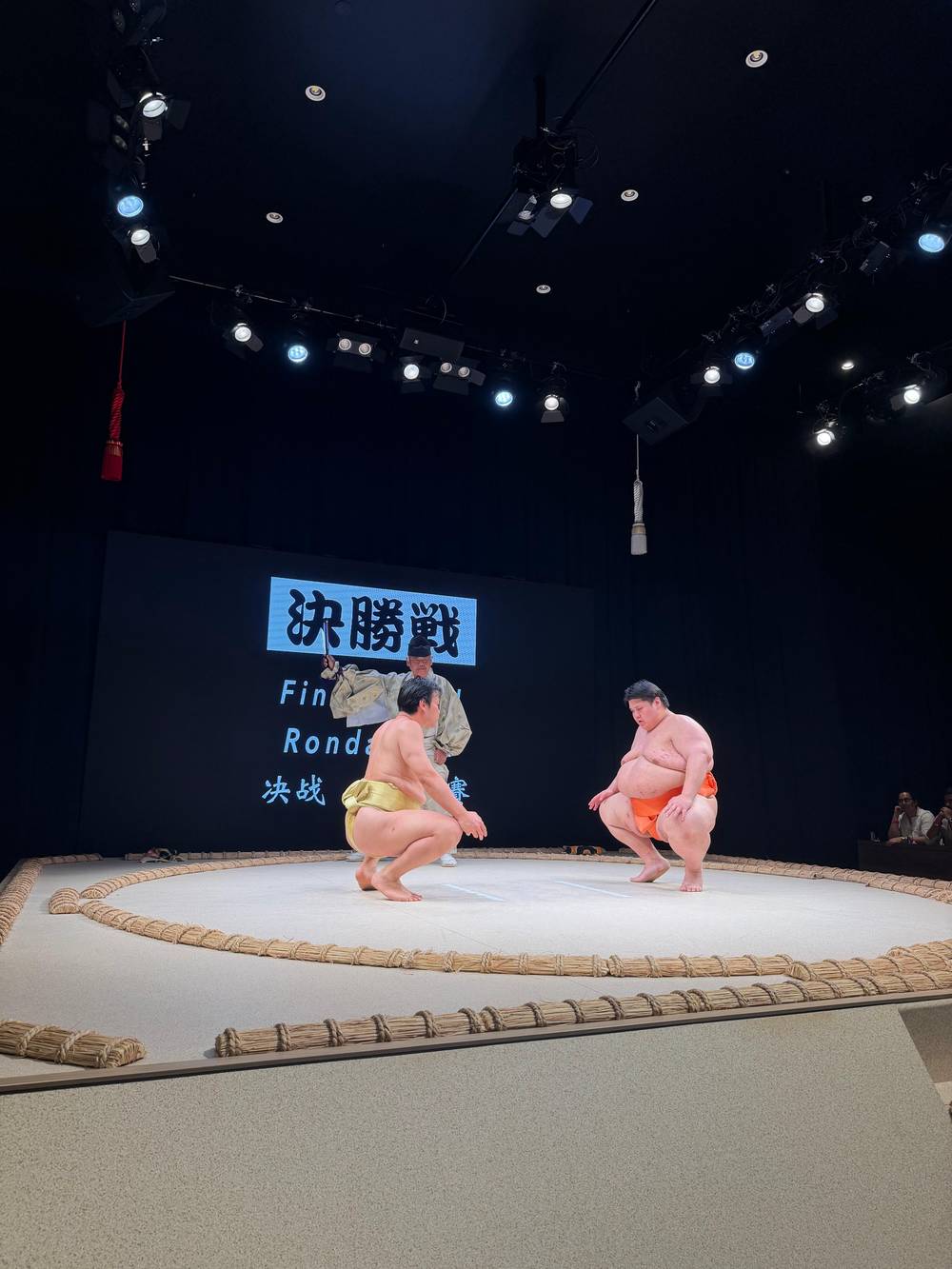
Sumostew on YouTube · Video data is requested only when you tap play.
No video replay, no electronic assistance - the results are judged by a group of professional referees lined up outside the ring.
FAQ
The first to step outside the ring or touch the ground with anything but the soles of the feet loses.1
JNTO says many bouts end within seconds, though some run for several minutes.2
GO TOKYO says it is meant to ward off evil spirits and ask for blessing and a bout without injury.3
Professional referees judge from outside the ring, and a rematch follows in rare inconclusive cases.1
JNTO says the six divisions are not delineated by weight.13
Ticket Oosumo gave around 2 PM for the top-division matches at the Osaka tournament.15
Ticket Oosumo says shoes come off before you step into a box.20
A bureau page says women can wear sumo suits and enter the ring at Active Square Daito.27
Sources
Read next
Torn between a show and the March tournament? A real person answers here.